ALT by Cyma Forma Review: A Generative Analog Synthesizer That Changed the Way I Think About Sound Design
Whenever an instrument manages to surprise me during a real production session, I know it deserves more than a quick first impression. That is exactly what happened when I had the opportunity to spend several hours with ALT by Cyma Forma while working on a sound design project in a friend’s studio. Although the synthesizer is not part of my personal setup, the session gave me enough time to move beyond its specifications and experience how it behaves in a genuine creative environment.
Many synthesizers promise endless experimentation, yet relatively few manage to encourage exploration without becoming unnecessarily complicated. ALT immediately stood out because it does not ask you to think in terms of traditional synthesis alone. Instead, it invites you to interact with evolving systems, probability, modulation, and controlled unpredictability, making every sound feel alive rather than programmed.
After years of working with analog synthesizers, Eurorack systems, grooveboxes, and software instruments, I have become increasingly selective about gear that genuinely introduces something different into the creative process. New instruments appear constantly, but very few manage to reshape the way I approach composition and sound design. During my time with ALT, I quickly realized that Cyma Forma had created something that feels less like another synthesizer and more like a creative ecosystem built around continuous evolution.
In this Cyma Forma review, I will share my impressions after using ALT in a real studio session, explain why its workflow immediately caught my attention, and discuss whether this unique analog generative synthesizer truly offers something different from the countless instruments already available today.
What Is ALT by Cyma Forma?
At first glance, ALT immediately communicates that it does not belong to the traditional family of keyboard synthesizers. There are no piano keys inviting conventional performance, nor is there a familiar subtractive architecture encouraging predictable programming. Instead, every design decision suggests that the instrument has been conceived around interaction, experimentation, and autonomous sonic evolution.
Cyma Forma describes ALT as an analog generative synthesizer, and after spending time with it, that definition feels remarkably accurate. Rather than focusing exclusively on manually performing melodies, the instrument allows musicians to build dynamic systems capable of generating continuously evolving textures, drones, sequences, and complex rhythmic structures. Every interaction influences the behavior of the instrument, often leading to musical ideas that would be difficult to imagine through conventional programming alone.
What impressed me most during the session was not simply the number of available features, but how naturally they interacted with one another. Instead of feeling like isolated modules, the oscillators, modulation sources, sensors, and routing options behave as parts of a single creative organism. Small adjustments often trigger surprisingly complex reactions, encouraging exploration instead of precision editing.
This philosophy makes ALT particularly appealing for musicians working in ambient music, experimental electronic production, cinematic composition, installation art, modular synthesis, and advanced sound design. However, I quickly realized that its potential extends well beyond these genres. Even producers focused on more structured electronic music could easily incorporate ALT as a constantly evolving layer capable of adding movement, texture, and unpredictability to otherwise static arrangements.
First Impressions: An Instrument Designed to Be Explored
The first few minutes with ALT were enough to understand that approaching it with conventional expectations would have been a mistake.
Unlike many modern synthesizers that encourage immediate preset browsing, ALT rewards curiosity from the very beginning. There is no obvious “correct” workflow waiting to be followed. Instead, the instrument constantly invites experimentation, encouraging you to observe how small changes influence the entire sonic ecosystem.
During our sound design session, I found myself spending far less time trying to recreate familiar sounds and considerably more time discovering unexpected interactions. That shift in mindset was perhaps the most enjoyable aspect of the experience. Rather than programming individual notes or building conventional patches, I was effectively designing evolving behaviors.
One particularly interesting aspect was how quickly ALT blurred the distinction between performer and listener. After configuring several modulation paths and introducing subtle variations, the instrument began producing movements that felt organic rather than repetitive. Instead of constantly making adjustments, I often preferred to step back, listen carefully, and decide which evolving moments deserved further development.
This kind of interaction feels surprisingly refreshing in an era where software instruments often encourage endless visual editing. ALT shifts the attention back toward listening, observation, and intuition, making every creative decision feel more connected to the sound itself than to a computer screen.
Build Quality and Industrial Design
Before discussing the sound itself, it is worth acknowledging the physical instrument because ALT immediately conveys a strong identity.
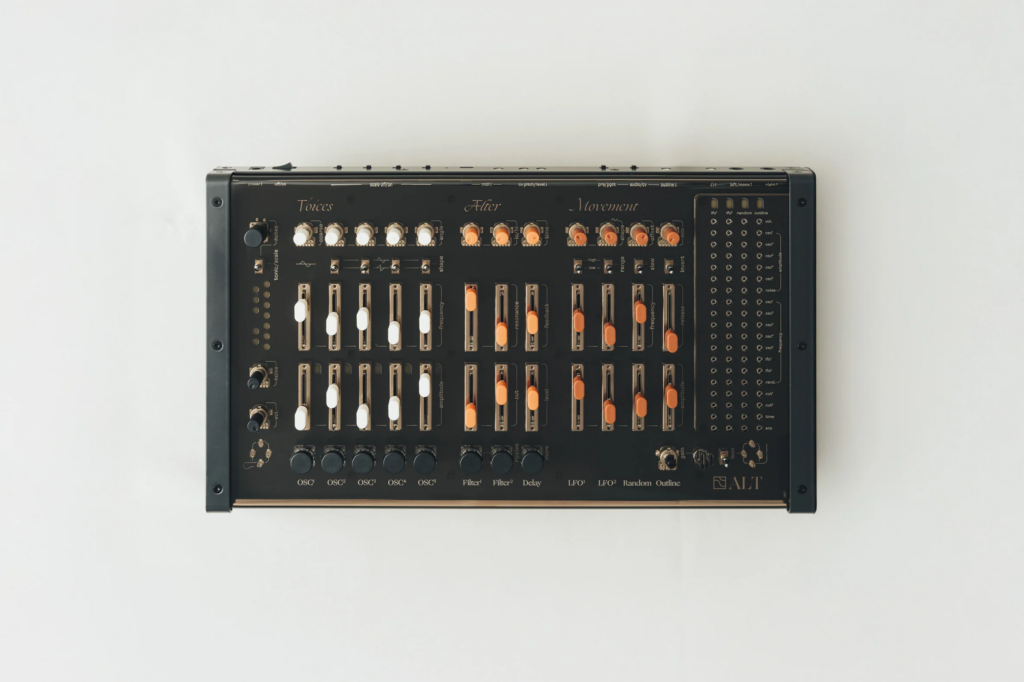
Cyma Forma has clearly avoided following the visual language adopted by many contemporary synthesizer manufacturers. Rather than emphasizing retro aesthetics or minimalist Scandinavian design alone, ALT presents itself as a modern creative object whose appearance directly reflects its experimental philosophy.
The overall construction immediately inspired confidence during the session. Every encoder felt solid, the controls offered satisfying resistance, and the instrument maintained a reassuring sense of robustness despite encouraging constant physical interaction. Since ALT invites continuous experimentation rather than occasional parameter adjustments, tactile quality becomes an essential part of the overall experience.
One element that particularly caught my attention was the thoughtful organization of the interface. Despite the large number of available functions, the panel never felt visually overwhelming. After a relatively short period of exploration, navigating between different sections became surprisingly intuitive, allowing the creative process to remain focused on listening rather than searching for controls.
Another aspect that deserves recognition is the inclusion of unconventional interaction methods. Rather than relying exclusively on knobs and buttons, ALT incorporates alternative ways of influencing sound generation, making the instrument feel alive in a way that extends beyond traditional synthesis techniques. These design decisions contribute significantly to its identity and reinforce the impression that ALT was conceived as an instrument for exploration rather than repetition.
The Sound Engine: Organic, Expressive, and Constantly Evolving
One of the reasons ALT left such a strong impression on me was not simply because it sounds good—many analog synthesizers do—but because it encourages sounds that rarely remain static for more than a few seconds. Even when a patch appears relatively simple at first, subtle movements continue to unfold beneath the surface, giving the impression that the instrument is constantly responding to itself.
That quality became particularly evident while we were building atmospheric layers for a sound design session. Instead of repeatedly reaching for envelopes or automation to introduce variation, ALT naturally generated movement through its internal architecture. The result was less mechanical than what I would normally expect from a sequenced synthesizer, and considerably more organic than many software-based generative environments.
The oscillators themselves possess a pleasant analog character that immediately feels substantial without becoming overly aggressive. Drones retain enough harmonic richness to remain interesting over extended periods, while melodic textures can evolve gradually without losing clarity. Even after several minutes, there was always some small detail emerging from the background that encouraged further listening.
What impressed me even more, however, was the relationship between stability and unpredictability. ALT never felt random in the frustrating sense of the word. Instead, it behaves almost like an experienced improviser: capable of surprising you while still remaining coherent with the musical direction you’ve established.
The Pin Modulation Matrix Is Where ALT Truly Comes Alive
Every synthesizer has a defining feature that shapes its personality. In the case of ALT, I would argue that the modulation system is the heart of the entire instrument.
Rather than hiding modulation inside menus or requiring endless pages of assignments, Cyma Forma opted for a physical pin matrix that transforms routing into a genuinely tactile experience. At first glance, the concept may seem unusual, especially for musicians accustomed to software modulation matrices. However, after spending some time experimenting with different signal paths, the advantages quickly become apparent.
Instead of thinking in terms of numbers, destinations, and percentages, you begin thinking about relationships. Every new connection immediately changes the behavior of the instrument, often encouraging ideas that would never have emerged through conventional programming.
During our session, we repeatedly found ourselves inserting and removing connections simply to observe how the system reacted. Sometimes the result was subtle, introducing barely perceptible movement within an evolving drone. Other times, the instrument transformed dramatically, producing rhythmic structures or harmonic variations that completely changed the direction of the sound.
Sensors That Turn the Surrounding Environment Into Part of the Instrument
Among the features that fascinated me the most are the integrated sensors.
Although many modern synthesizers offer extensive modulation options, relatively few invite the physical environment itself to participate in the creative process. ALT approaches interaction from a very different perspective by allowing external elements to influence sound generation in surprisingly natural ways.
During the session, we experimented with changes in lighting and movement around the instrument, observing how these subtle environmental variations affected different parameters. Rather than behaving like a gimmick, the sensors introduced gentle fluctuations that made already evolving patches feel even more alive.
The integrated microphone follows the same philosophy.
Instead of serving merely as an audio input, it becomes another modulation source capable of reacting to external sounds, voices, or percussive gestures occurring within the room. This transforms ALT into something that feels partially connected to its surroundings rather than isolated from them.
For experimental musicians, installation artists, and composers working with generative systems, these capabilities dramatically expand the instrument’s expressive possibilities. Even relatively small interactions can create entirely new sonic behaviors without requiring complex programming.
What I appreciated most is that these features never seemed forced. They integrate naturally into the instrument’s broader philosophy, reinforcing the idea that ALT is designed to evolve continuously rather than repeat identical performances.
A Workflow That Encourages Listening Instead of Editing
Modern music production often revolves around visual feedback.
Large computer monitors display automation curves, modulation graphs, MIDI editors, and countless plugin windows competing for attention. Although these tools are undeniably powerful, they sometimes encourage producers to make decisions based on what they see rather than what they actually hear.
ALT almost completely reverses that process. As a result, within minutes, I noticed that my attention had shifted away from the controls themselves and toward the sound unfolding inside the room. Instead of asking whether another modulation assignment was technically possible, I found myself asking whether the evolving texture actually felt musically interesting.
That subtle change in mindset had a surprisingly positive effect on creativity.
Rather than continuously tweaking parameters, I spent considerably more time listening patiently, waiting for moments worth developing further. Sometimes those moments emerged gradually over several minutes, rewarding restraint rather than constant intervention.
This slower, more contemplative workflow feels particularly valuable for ambient music, cinematic composition, and experimental sound design, where evolution often matters more than immediate impact.
Nevertheless, I do not believe ALT should be viewed exclusively as an ambient instrument. Many of the generated ideas could easily become starting points for techno, IDM, downtempo, or even more conventional electronic productions. In fact, one of its greatest strengths lies precisely in its ability to generate unexpected material that can later be sampled, rearranged, or integrated into completely different musical contexts.
For producers accustomed to beginning every project with an empty piano roll, ALT offers a radically different way of generating inspiration.
Using ALT During a Real Sound Design Session
One of the aspects I appreciated most about testing ALT was the context in which I experienced it. This was not a quick demonstration at a trade show, nor was it a brief hands-on session inside a music store where time is limited and distractions are everywhere. Instead, I had the opportunity to work with the instrument in a friend’s studio while we were developing material for a sound design project, which allowed me to approach it exactly as I would any other piece of professional equipment.
That distinction matters because the way an instrument behaves during an actual creative session is often very different from the impression it gives during a short demo. Features that initially seem exciting can quickly become repetitive, while more subtle design choices often reveal their value only after spending several hours working with them.
Fortunately, ALT belongs firmly to the second category.
Rather than constantly trying to impress with dramatic sounds, it gradually reveals its strengths through exploration. The longer we worked with it, the more interesting possibilities emerged, and the instrument consistently encouraged us to move away from familiar production habits.
During the session, we were looking for evolving textures capable of supporting cinematic atmospheres without becoming repetitive. Normally, that type of material requires layering several synthesizers together with generous amounts of automation, modulation, and post-processing. ALT, however, generated surprisingly rich movement almost by itself, leaving us free to focus on shaping the overall direction instead of manually creating every small variation.
There were several moments when a simple adjustment unexpectedly transformed the entire patch into something neither of us had anticipated. Rather than interrupting the workflow, those happy accidents became some of the most inspiring moments of the afternoon.
For me, that is one of the clearest indicators that an instrument has genuine creative value. If a synthesizer repeatedly encourages new musical ideas instead of simply executing existing ones, it becomes more than a sound source—it becomes a creative partner.
Where ALT Fits in a Modern Studio
Although ALT immediately attracted my attention because of its experimental nature, I do not think it should be viewed as a niche instrument reserved exclusively for modular enthusiasts or avant-garde composers.
In reality, I can imagine it fitting comfortably into a wide range of professional studios, particularly those where originality and sonic identity are considered essential parts of the production process.
Sound designers are perhaps the most obvious audience. For example, whether the goal is creating evolving ambiences for film, designing textures for video games, or producing unique samples that can later be manipulated inside a DAW, ALT offers an impressive amount of raw material.
Ambient producers would also find plenty to appreciate. The instrument naturally excels at creating long-form evolving soundscapes, subtle harmonic movement, and drones that maintain interest over extended listening sessions without relying on excessive effects processing.
Electronic musicians working in genres such as techno, IDM, downtempo, or experimental electronica could equally benefit from its generative capabilities. Even if ALT never becomes the main melodic instrument within a production, it can continuously generate textures, rhythmic fragments, transitions, and unexpected sonic details that add depth to otherwise static arrangements.
What impressed me most is that the instrument does not demand to become the centerpiece of every composition. Instead, it integrates naturally into a broader creative workflow, contributing ideas rather than dominating the production.
Final Thoughts: More Than a Synthesizer
When I left the studio after spending time with ALT, I realized I was thinking less about individual features and far more about the creative process it had encouraged.
That, perhaps, is the highest compliment I can give any musical instrument.
Specifications eventually become outdated. Processing power increases. New synthesizers appear every year promising more oscillators, more voices, and more modulation than the previous generation. Yet very few pieces of hardware genuinely influence the way you think while making music.
ALT belongs to that rare category.
ALT belongs to that rare category. More importantly, rather than asking musicians to perform every note manually, it invites them to build systems capable of producing evolving musical behavior. The result is an instrument that feels equally comfortable generating subtle ambient textures, complex rhythmic structures, cinematic atmospheres, or entirely unpredictable sonic landscapes.
My experience with ALT was limited to a single but substantial studio session during a sound design project, so I cannot honestly comment on aspects such as long-term reliability or months of daily use. What I can confidently say, however, is that those hours were more than enough to understand why this instrument has attracted so much attention among producers searching for genuinely new creative workflows.
Cyma Forma has not simply designed another analog synthesizer.
For producers, composers, and sound designers looking to break away from predictable creative habits, ALT is undoubtedly one of the most fascinating instruments I have had the opportunity to experience in recent years.
Final Verdict
ALT by Cyma Forma is not the kind of synthesizer you buy because you need another analog voice in your studio. It is the kind of instrument you consider when your existing workflow no longer surprises you, and you want something capable of generating ideas that simply would not emerge through conventional programming.
Although my experience was limited to a real-world sound design session in a friend’s studio rather than long-term ownership, it left a lasting impression. Few instruments have managed to change the way I approached a creative session in such a short amount of time, and that alone says a great deal about what Cyma Forma has achieved.
If your work revolves around sound design, ambient music, experimental electronics, film scoring, or generative composition, ALT deserves a place on your shortlist. Not because it promises endless possibilities, but because it genuinely delivers a creative experience unlike almost anything else currently available.
For more technical details on ALT, you can check the official manual and the full specifications on Cyma Forma’s website or order it directly from the official store.
Written by Matthew S, producer and sound designer — matthewess.com
No Comments