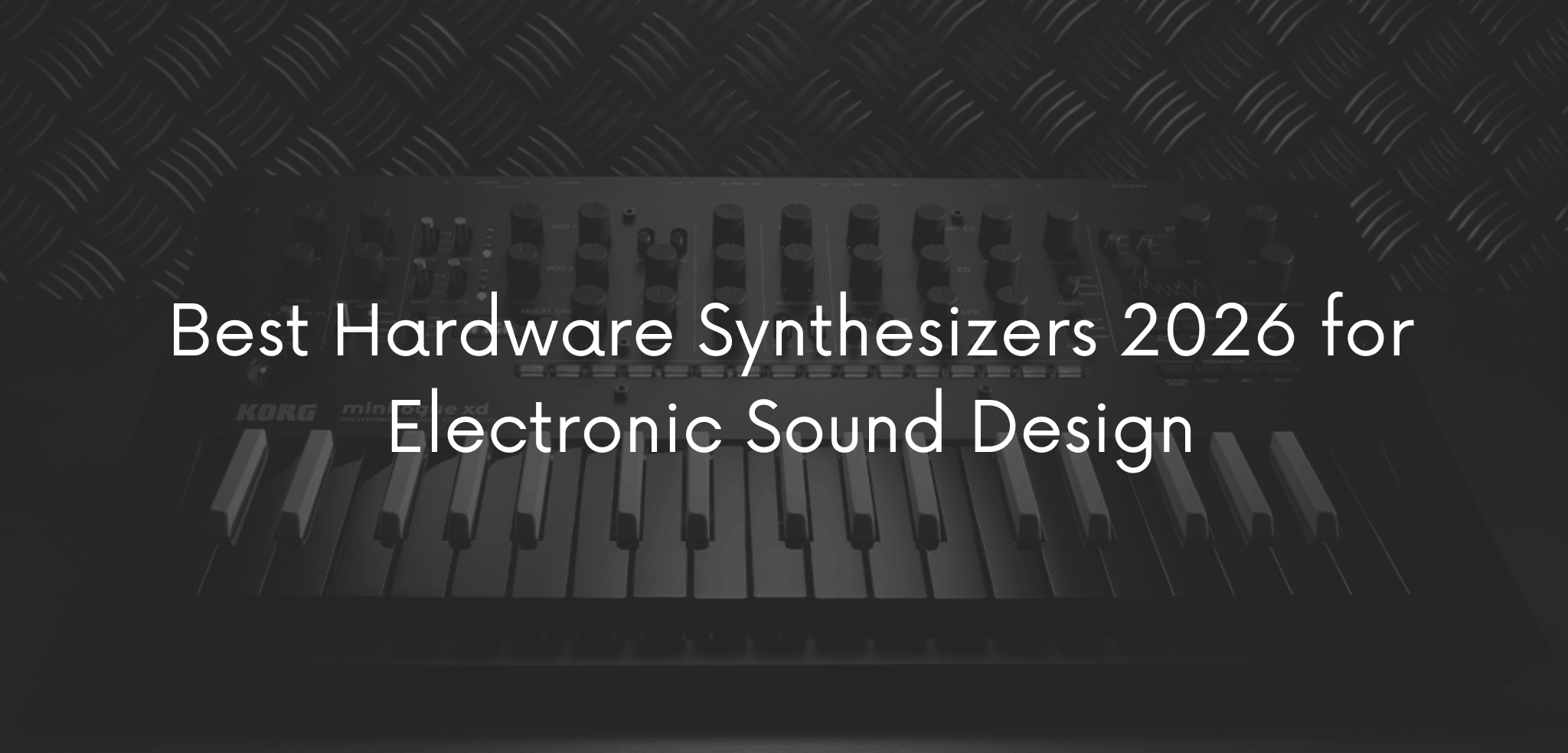
The best hardware synthesizers of 2026 for electronic sound design, sorted by price and synthesis type — a practical buying guide.
Why hardware synths are still worth it in 2026
With plugins like Massive X or Omnisphere now capable of impressive results, it’s natural to wonder whether spending money on a physical synth still makes sense. For anyone serious about sound design, the answer is yes — though for different reasons than a decade ago.
A hardware synth today doesn’t compete on raw sound quality anymore; it competes on interaction. Dedicated knobs for every parameter, analog filters that react unpredictably, the ability to improvise a patch while performing live — these are things a plugin, however powerful, can only partially replicate. The 2026 market reflects that philosophy, ranging from compact synths under $350 built around one strong sonic idea all the way up to flagship workstations costing thousands.
How to choose: analog, digital, or hybrid synthesis for sound design
Before looking at specific models, it’s worth clarifying one thing: for electronic sound design, there’s no single “best synth “overall”—there’s the right synth for the sound you’re chasing.
Analog synths offer warmth, organic imperfection, and filters with a character that’s hard to replicate digitally, making them ideal for basses, pads, and leads with personality. Digital/wavetable synths, on the other hand, open up timbral territory analog simply can’t reach—metallic textures, spectral morphing, granular synthesis—perfect for experimental sound design and more futuristic electronic music. Hybrid synths combine digital oscillators with analog filters, aiming to capture the best of both worlds.
Under $350: the best synth to start experimenting — Arturia MicroFreak
If your budget is tight but you still want a synth capable of a genuinely wide sonic range, the Arturia MicroFreak (around $299) remains the entry-level benchmark in 2026. Its strength lies in the variety of digital synthesis engines packed into a compact format, paired with a capacitive-touch keyboard and a Steiner-Parker analog filter that adds character to whichever engine you’re running. It’s the perfect instrument for figuring out, on a modest budget, which sonic direction actually interests you before investing in more specialized gear.
The classic analog voice — Korg Minilogue XD
For anyone after that classic warm analog polyphony as a foundation for sound-design pads and leads, the Korg Minilogue XD (around $580) remains the de facto standard of the mid-range in 2026. Four analog voices, each with two VCOs, deliver that recognizable poly-analog warmth; a third digital oscillator accepts user-loadable multi-engines, meaning the instrument keeps evolving well beyond the initial purchase. Rounding out the package are 37 slim keys, onboard effects, a polyphonic step sequencer, and CV inputs for anyone looking to expand into modular gear.
The aggressive character—Korg MS-20 Mini
When sound design calls for grit, noise, and edge rather than polish, the Korg MS-20 Mini remains unmatched. Its dual-filter architecture (high-pass and low-pass in series) produces an instantly recognizable sound: raw, aggressive, and deliberately unrefined — the exact opposite of more “well-mannered” analog synths. When the two filters resonate against each other, the interaction generates screaming, dirty textures that are the instrument’s sonic signature — perfect for acid basslines, industrial effects, and more extreme sound design work.
Wavetable and deep digital sound design — Waldorf Iridium and Korg Modwave MKII
For those wanting to push into timbral territory analog simply can’t reach, there are two complementary paths. The Waldorf Iridium combines wavetable, granular, resonator, and kernel synthesis across three oscillator slots that can be freely mixed — you can run wavetable, granular, and resonator simultaneously within the same patch. Its touchscreen with direct parameter editing makes deep synthesis engines accessible without endless menu-diving, a detail that matters when you’re experimenting and need to iterate fast.
The Korg Modwave MKII offers a more accessible middle ground: two wavetable oscillators paired with the Kaoss Physics XY pad, motion sequencing, and sample import, all in a compact 37-key format. It’s the right choice for anyone who wants serious wavetable synthesis without the Iridium’s budget and complexity.
Extreme modulation — ASM Hydrasynth
If your sound design lives and dies by modulation — multiple LFOs, complex matrices, constant sonic movement—the ASM Hydrasynth is built exactly for that. With five LFOs, a polyphonic aftertouch keyboard, and an extensive modulation matrix, plus CV/gate connectivity for anyone integrating it into a modular setup, it’s an instrument capable of generating constantly evolving soundscapes — ideal for film scoring, ambient electronica, or cinematic sound design.
Polyphony for pads and layering — Sequential Take 5 and Prophet REV2-16
When sound design calls for dense, layered pads, polyphony becomes the deciding factor. The Sequential Take 5 (around $1,599) delivers genuine analog polyphony with studio-grade build quality — the natural step up for anyone ready to move past entry-level synths. For even more demanding needs, the Sequential Prophet REV2-16 offers 16 voices of true analog synthesis with Curtis chip oscillators and filters: an architecture that lets you build massive, layered sounds where different voices contribute distinct timbral elements to a single key press—sound design territory that synths with fewer voices simply can’t reach.
The flagship workstation — Yamaha Montage M8x
For those wanting a single instrument that covers (almost) everything, the Yamaha Montage M8x represents the top of the workstation category in 2026. It combines the 8-operator FM-X engine, the AN-X engine (16 voices, three oscillators in AN1x style), and a significantly improved AWM2 engine for a combined maximum polyphony of 400 notes across all three engines—a genuinely massive sound design capability. The overhauled interface speeds up the programming workflow, while features like the Super Knob with more morph points, the Motion Sequencer, and the Envelope Follower let you build soundscapes other instruments simply can’t reach.
Summary table: which synth fits your goal
| Goal | Recommended synth | Price range |
|---|---|---|
| Start experimenting on a budget | Arturia MicroFreak | ~$299 |
| Versatile polyphonic analog foundation | Korg Minilogue XD | ~$580 |
| Aggressive character, acid bass, industrial | Korg MS-20 Mini | mid-range |
| Advanced wavetable/granular sound design | Waldorf Iridium | high-end |
| Accessible wavetable synthesis | Korg Modwave MKII | mid-range |
| Extreme modulation, ambient/cinematic | ASM Hydrasynth | upper-mid |
| Dense pads, polyphonic layering | Sequential Take 5 / Prophet REV2-16 | high-end |
| All-in-one workstation | Yamaha Montage M8x | flagship |
FAQ
Is it still worth buying a hardware synth in 2026 if I already have plugins like Massive X? Yes, if you value the physical interaction and unpredictability hardware offers. If your only goal is final sound quality, a good plugin can be enough today — it’s more a workflow decision than a sound-quality one.
What’s the best hardware synth to start with on a limited budget? The Arturia MicroFreak remains the benchmark under $350, thanks to the variety of synthesis engines packed into a compact format.
Analog or digital for electronic sound design? It depends on the sound you’re after: analog delivers warmth and organic character, while digital/wavetable opens up timbral territory analog can’t reach. Many sound designers end up owning both.
Does it make sense to buy a flagship workstation as a first synth? Generally, no — it’s better to start with a simpler, more focused instrument and move to a workstation once you already know exactly what you need.
Conclusion
There’s no single “definitive” synth for electronic sound design — there’s the right instrument for the stage you’re at and the sound you’re trying to reach. If you’re still building out the rest of your setup, check out the Home Studio Essentials for Beginners in 2026 guide to see how a hardware synth fits into your home studio.