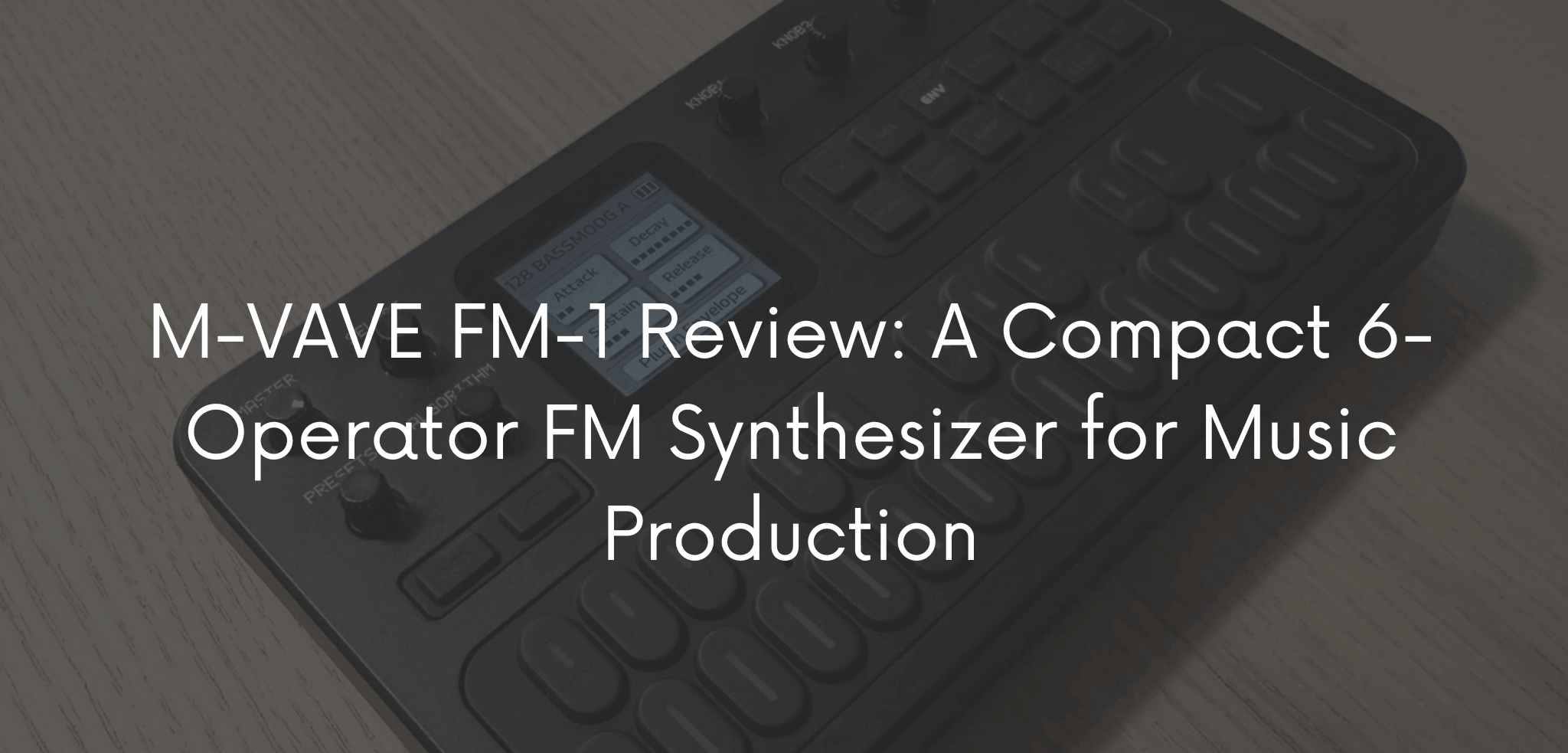
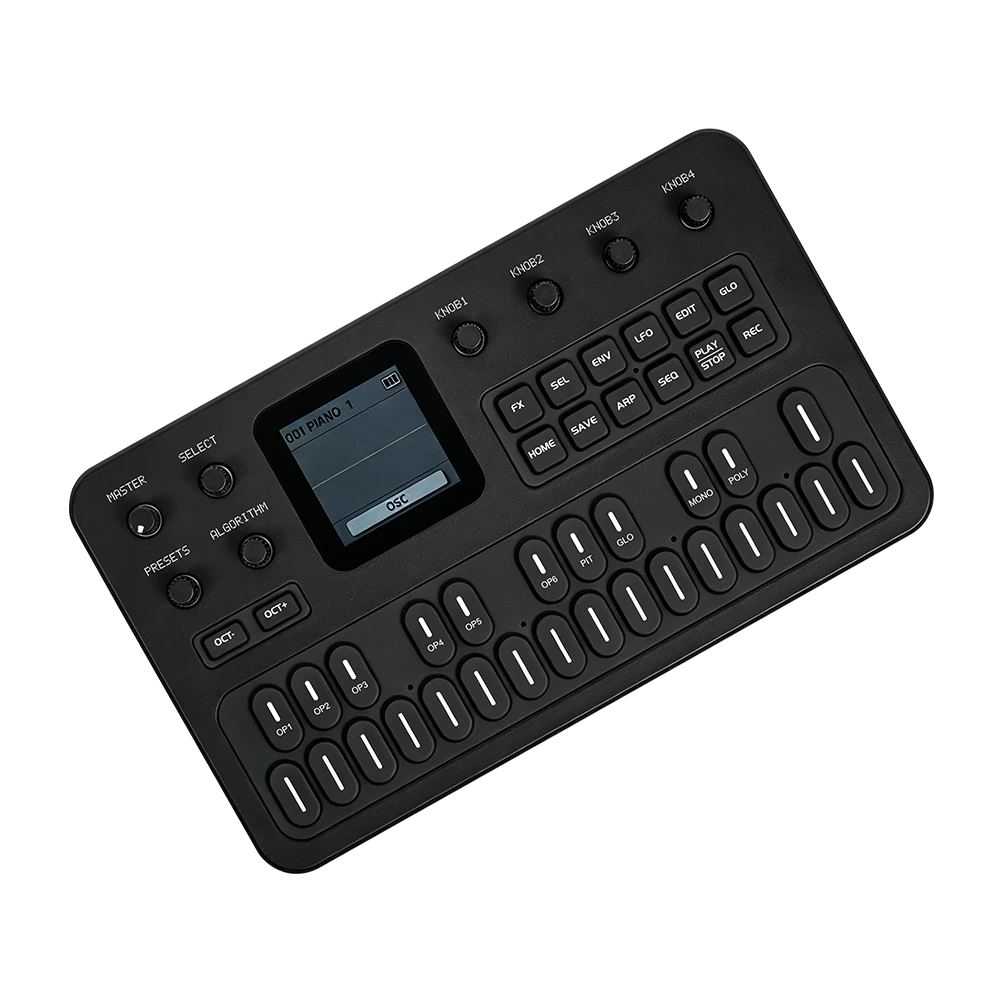
The M-VAVE FM-1 is a remarkably compact hardware synthesizer built around a six-operator FM engine. Despite its small footprint, the instrument combines 32 algorithms, 128 presets, an arpeggiator, a 16-step sequencer, MIDI connectivity, built-in effects, a rechargeable battery and a built-in speaker.
At first glance, that feature set makes the FM-1 look like an unusually ambitious pocket synthesizer. However, specifications alone do not tell us whether an instrument is genuinely useful. For producers, the more important questions are how it sounds, how easily it integrates with a DAW, how practical its interface is and where it fits within a modern home studio.
BUY HERE: FM-1 A Pocket FM Synthesizer
M-VAVE officially describes the FM-1 as a Pocket FM Synthesizer. The company’s product information highlights six operators, 32 algorithms, 128 presets, ARP, a 16-step sequencer and triple MIDI connectivity. M-VAVE FM-1 official product page
That combination gives the FM-1 a clear identity. Rather than trying to replace a full-size workstation, it focuses on putting classic FM synthesis into an extremely portable format.
There is also an important distinction to make from the beginning. The FM-1 is a synthesizer, not a studio monitor. Its built-in speaker is designed for convenient standalone playback, while critical mixing still requires proper studio monitors or headphones.
What Is the M-VAVE FM-1?
The M-VAVE FM-1 is a compact digital synthesizer based on frequency modulation synthesis, commonly known as FM synthesis.
Unlike traditional subtractive synthesis, where an oscillator is typically shaped with filters and envelopes, FM synthesis creates complex tones by using one oscillator to modulate the frequency of another. Multiple operators can then be connected in different configurations to create different harmonic structures.
This approach became particularly famous through instruments such as the Yamaha DX7. Today, FM remains useful for producing electric pianos, bells, basses, digital keys, metallic sounds and unusual textures.
The FM-1 brings this type of synthesis into a very small hardware instrument. In addition, its internal sequencer, arpeggiator and effects make it more than a simple FM sound module.
Key Features at a Glance
- 6 FM operators
- 32 algorithms
- 128 presets
- Up to 12-voice polyphony according to available documentation
- 27-key silicone keyboard
- Color display
- Built-in effects
- Arpeggiator
- 16-step sequencer
- USB-C connectivity
- MIDI connectivity
- Bluetooth MIDI
- Built-in speaker
- Rechargeable battery
- Compact portable design
M-VAVE FM-1 Specifications
| Feature | M-VAVE FM-1 |
|---|---|
| Type | Pocket FM synthesizer |
| Synthesis | FM |
| Operators | 6 |
| Algorithms | 32 |
| Presets | 128 |
| Polyphony | Up to 12 voices |
| Keyboard | 27-key silicone keyboard |
| Display | Color TFT display |
| Effects | Filter, reverb, delay, distortion, chorus, phaser |
| Arpeggiator | 7 modes according to available documentation |
| Sequencer | 16 steps |
| MIDI | USB-C MIDI, Bluetooth BLE MIDI and 3.5 mm MIDI |
| Audio output | 3.5 mm stereo output |
| Speaker | Built-in |
| Battery | 2000 mAh rechargeable battery |
| Approximate battery life | Up to around 12 hours according to available documentation |
| Dimensions | Approximately 161.5 × 96.5 × 28.6 mm |
| Weight | Approximately 251 g |
Because firmware can change the capabilities of a hardware instrument, the manufacturer’s current download information should always be checked before publishing a permanent specification table. M-VAVE provides dedicated FM-1 firmware and software downloads. M-VAVE downloads
Design and Build
Portability is arguably the first thing that defines the FM-1.
The synthesizer is small enough to fit comfortably beside a laptop, MIDI controller or audio interface. Consequently, it makes sense for producers who want another hardware sound source without adding a large keyboard to an already crowded desk.
The compact design does involve compromises, though.
Instead of a conventional piano-style keyboard, the FM-1 uses a small silicone keyboard. This is perfectly adequate for auditioning sounds, programming short melodies and playing bass lines. For more expressive performance, however, most musicians will probably prefer an external MIDI keyboard.
That is not necessarily a weakness. In a studio, the FM-1 can simply function as the sound engine while a larger controller handles performance.
The same design also makes the instrument easier to carry. A producer can move it from the studio to another room, a rehearsal space or a travel setup without treating it like a piece of bulky studio equipment.
The 27-Key Keyboard
The integrated keyboard is one of the features that makes the FM-1 genuinely standalone.
You do not need an external MIDI controller just to play the instrument. Instead, melodies, bass parts, chords and simple sequences can all be entered directly from the FM-1.
For serious keyboard performance, the limitations become more apparent. The compact keys do not provide the playing experience of a full-size synthesizer or piano keyboard.
Nevertheless, the arrangement works well for the FM-1’s intended role.
A portable synthesizer does not necessarily need to provide a professional performance keyboard. It simply needs to remain playable when no larger controller is available.
Display and User Interface
FM synthesis can become complicated surprisingly quickly.
With six operators and multiple algorithms, the relationship between different sound-generation stages matters considerably. Fortunately, the FM-1 uses a color display to make the interface easier to understand.
Available documentation shows the FM algorithms graphically, allowing users to see how the operators are connected. That visual approach is useful because it gives the abstract algorithm structure a more immediate representation.
For someone learning FM synthesis, this can be especially helpful.
Instead of thinking only in terms of algorithm numbers, the user can begin to understand the relationship between carriers and modulators. As a result, the interface can become part of the learning process rather than simply a way to access presets.
The controls are inevitably small, however. Anyone expecting a large panel covered with dedicated FM controls will find the FM-1 much more menu-oriented.
Six-Operator FM Synthesis
The heart of the instrument is its six-operator FM architecture.
M-VAVE specifies 32 algorithms, with each algorithm defining a different arrangement of the operators. M-VAVE FM-1 specifications
That matters because the algorithm determines the basic architecture of the sound.
Some configurations are useful for relatively straightforward tones, while others can create much more complex harmonic relationships. By adjusting the operators and their envelopes, users can move from familiar electric-piano sounds toward aggressive, metallic or highly digital textures.
This is where the FM-1 differs significantly from many small budget synthesizers.
A conventional subtractive synthesizer might offer multiple oscillators, a filter and modulation sources. The FM-1 instead gives the producer access to a synthesis method that behaves very differently.
Electric Piano Sounds
FM synthesis is particularly famous for electric-piano tones.
The technique can produce the bright attack, complex upper harmonics and characteristic digital character associated with classic FM electric pianos. Therefore, this is one of the first areas where many producers will probably explore the FM-1.
These sounds can work well in pop, electronic music, ambient productions and soundtrack-oriented arrangements.
Bells and Mallets
Bell-like sounds are another natural application.
The harmonic relationships created by FM can produce bright partials and inharmonic components that are difficult to achieve with a simple subtractive patch. Consequently, the FM-1 can be useful when a track needs a melodic sound that sits somewhere between a keyboard, percussion instrument and synthetic texture.
FM Bass
FM bass can occupy a different space from the warmer bass tones commonly associated with analog-style synthesis.
Depending on the patch, it can be clean and controlled or extremely harmonically dense. That contrast makes the FM-1 useful alongside a conventional subtractive synthesizer.
For example, one hardware synth could handle a rounded analog bass while the FM-1 supplies a brighter digital layer.
Digital and Metallic Textures
Sound designers will probably find the FM architecture particularly interesting here.
Changing modulation levels and operator relationships can dramatically alter the harmonic content. As a result, relatively small parameter changes can transform a familiar patch into something much more aggressive or unusual.
That makes the FM-1 useful for transitions, sound effects, experimental melodies and synthetic percussion.
How Does the M-VAVE FM-1 Sound?
The FM-1 is clearly designed around the characteristic sound world of six-operator FM synthesis.
Independent testing has also compared its architecture with the classic DX7 approach and reported compatibility with DX7 SysEx patches. However, compatibility should not be interpreted as proof that the FM-1 sounds exactly like an original DX7. Independent FM-1 review and testing
That distinction is important.
The attraction here is access to the FM synthesis concept, rather than an exact recreation of a vintage instrument.
For producers, this is arguably the more useful way to look at it. The FM-1 can provide familiar FM-style timbres while also functioning as a small experimental synthesis platform.
Presets and Sound Exploration
The FM-1 provides 128 presets, according to M-VAVE’s product information. M-VAVE product information
Presets are particularly valuable with FM synthesis because they provide an immediate reference point.
A beginner can select an electric piano, bell or bass sound and then start changing individual parameters. Gradually, the relationship between modulation and timbre becomes easier to understand.
More experienced users can instead treat the presets as raw material.
Starting with a usable patch and modifying its operator structure can be much faster than building every sound from an initialized patch.
DX7 SysEx Compatibility
One of the FM-1’s more interesting capabilities is its relationship with the enormous ecosystem of classic FM sounds.
Available documentation and independent testing indicate that the instrument can work with compatible DX7 SysEx patches. Independent FM-1 testing
For musicians familiar with classic FM synthesis, that considerably expands the potential sound library.
Still, a compatible patch format does not automatically mean identical sound reproduction. Hardware implementation, envelopes, tuning and other details can influence the result.
Therefore, it is more accurate to describe the FM-1 as a six-operator FM synthesizer with access to compatible DX7-style sounds, rather than simply calling it a DX7 clone.
Built-In Effects
The FM-1 includes several effects designed to make its sounds more immediately usable.
Available documentation identifies:
- filter
- reverb
- delay
- distortion
- chorus
- phaser
These effects help turn the FM-1 into a more self-contained instrument.
For example, chorus can give an electric-piano patch more width, while reverb can place a bell sound further into a virtual space. Similarly, distortion can emphasize the upper harmonics produced by FM synthesis.
The internal effects are not intended to replace a professional DAW effects collection. Instead, they make the hardware more enjoyable to use on its own.
Once the instrument is connected to a DAW, producers can always add software processing afterwards.
Arpeggiator
The FM-1 includes an arpeggiator with multiple modes according to the available documentation.
That feature is particularly useful for electronic music because it can turn a simple chord into a repeating melodic pattern.
A producer might hold a chord, select an arpeggiator pattern and then adjust the FM sound while the sequence continues playing.
This approach works well for:
- electronic music
- synthwave
- ambient
- house
- experimental music
- songwriting
- live performance
Moreover, the arpeggiator makes the FM-1 more engaging when used without a computer.
16-Step Sequencer
M-VAVE lists a 16-step sequencer among the FM-1’s main features. M-VAVE product information
A 16-step pattern is obviously much more limited than a modern DAW timeline. Nevertheless, it is useful for sketching short bass lines, melodies and rhythmic ideas.
The most effective workflow is probably not to treat it as a complete production environment.
Instead, use the sequencer as a creative starting point. Build a pattern, experiment with the sound and then move the musical idea into the DAW when the arrangement needs more flexibility.
M-VAVE FM-1 in a Home Studio
The FM-1 makes the most sense in a studio as a compact additional sound source.
A typical setup could be:
FM-1 → audio interface → DAW → studio monitors
MIDI can then be used to control the instrument from the computer or an external controller.
This arrangement provides a useful division of responsibilities. The FM-1 handles synthesis, while the DAW takes care of recording, editing, arrangement, automation and mixing.
Recording the FM-1
Recording the instrument into a DAW is straightforward in principle.
A producer can create a MIDI track, play the FM-1, edit the MIDI performance and then record the resulting sound as audio.
This workflow has a practical advantage: the FM-1 becomes another dedicated hardware voice in the studio without requiring a large amount of desk space.
It can contribute:
- bass lines
- melodies
- electric-piano parts
- pads
- arpeggios
- sequences
- sound effects
- experimental textures
Once recorded, those sounds can be treated exactly like any other audio source.
Music Production
For music production, the FM-1’s greatest advantage is probably variety.
Many producers already have access to numerous subtractive software synthesizers. Adding another synth based on the same architecture does not necessarily expand the available palette very much.
FM synthesis does.
The FM-1 can therefore complement rather than duplicate an existing collection of instruments.
For instance, an analog-style synthesizer might provide a warm pad while the FM-1 supplies a bright digital counterpoint. The difference in synthesis architecture can create useful contrast within an arrangement.
Songwriting
Hardware can also change the creative process.
Opening a large DAW session often means making decisions about plugins, tracks and routing before any music has been written. By contrast, a small hardware synthesizer can be switched on and played almost immediately.
The FM-1 is well suited to this kind of sketching.
Its keyboard, presets, speaker and battery make it possible to experiment without building a complete studio setup first.
MIDI Connectivity
MIDI is one of the FM-1’s strongest features for studio users.
M-VAVE highlights triple MIDI connectivity, while available documentation identifies USB MIDI, Bluetooth BLE MIDI and a 3.5 mm MIDI connection. M-VAVE product information
This flexibility allows the synthesizer to occupy different positions in a hardware setup.
For example, it can be controlled from a computer, an external MIDI keyboard or another MIDI device, depending on the configuration.
That makes the FM-1 more useful than a standalone toy instrument.
Instead, it can become a small but legitimate part of a larger MIDI ecosystem.
USB-C and DAW Integration
USB-C is particularly convenient for computer-based production.
Available documentation and independent testing indicate that the FM-1 can operate with USB MIDI and USB audio functionality. Independent FM-1 testing
Consequently, the FM-1 can be integrated into a modern computer setup without requiring a complicated collection of connections.
For a small home studio, that simplicity is valuable.
The producer can keep the FM-1 beside the computer and use it when a dedicated hardware FM voice is needed.
Built-In Speaker
A built-in speaker makes the FM-1 considerably more portable.
You can audition presets, play melodies or work on a sequence without immediately connecting external speakers or headphones.
That is useful when travelling or simply experimenting away from the main studio.
However, the speaker should be viewed as a convenience feature, not a monitoring solution.
Critical mixing decisions should still be made using reliable studio monitors or headphones.
Audio Output
The FM-1 provides a 3.5 mm stereo audio output according to available documentation.
For a portable instrument, this connector makes sense because it keeps the hardware small.
In a conventional studio, however, users may need an appropriate adapter or cable to connect it to an audio interface with standard quarter-inch inputs.
That is a minor consideration, but it is worth planning before integrating the instrument into a permanent setup.
Independent testing has also discussed the FM-1’s internal signal architecture and stereo output behaviour. For advanced users, this is worth considering when designing a more complex studio routing setup.
Battery Life and Portability
The FM-1 includes a rechargeable 2000 mAh battery, with available documentation indicating approximately 12 hours of operation.
This feature significantly changes how the instrument can be used.
Instead of being permanently attached to a studio power supply, the FM-1 can accompany the musician into different environments.
For example, it can be used during travel, songwriting sessions, rehearsals or casual sound-design sessions away from the computer.
Portability is therefore not just a marketing feature. It changes the potential workflow.
Is the M-VAVE FM-1 Good for a Home Studio?
Yes, particularly as a secondary synthesizer.
The FM-1 does not need to replace an existing keyboard or software collection. Instead, it can add a dedicated FM sound source to the setup.
That role makes considerable sense for smaller studios.
A producer can gain access to a different synthesis architecture without giving up a large amount of desk space. Furthermore, the built-in battery and keyboard make the instrument useful outside the studio as well.
Is the M-VAVE FM-1 Good for Mixing?
No — and that is not what it is designed for.
The FM-1 generates sounds. It does not replace an audio interface, mixing console, DAW or studio monitoring system.
Its built-in speaker is useful for checking sounds and playing the instrument, but it is not designed for accurate critical listening.
The sensible workflow is therefore:
FM-1 for synthesis → DAW for production → studio monitors or headphones for mixing.
Keeping those roles separate avoids one of the most common misunderstandings about compact music-production hardware.
Is the M-VAVE FM-1 Good for Mastering?
No.
Mastering requires accurate monitoring and dedicated processing tools. The FM-1 is not intended to perform that role.
Its contribution happens much earlier in the production chain: it creates the musical material that eventually becomes part of a finished recording.
M-VAVE FM-1 vs Yamaha DX7
Comparisons with the Yamaha DX7 are inevitable because of the six-operator FM architecture.
The original DX7 was a full-size professional synthesizer with a very different physical interface and workflow. The FM-1 takes the opposite approach: it prioritizes compact dimensions, portability and accessibility.
Therefore, the more useful comparison is conceptual.
If you want the exact experience of using a vintage DX7, the FM-1 is not a substitute.
If you want a portable way to explore six-operator FM synthesis and compatible classic sounds, it becomes a much more interesting proposition.
M-VAVE FM-1 vs Software FM Synthesizers
Software has several obvious advantages.
A plugin can provide a large interface, automation, unlimited presets, easy project recall and deep DAW integration. In addition, software FM instruments can often expose far more parameters simultaneously.
Hardware, however, changes the experience.
The FM-1 provides a dedicated physical instrument that can be played without opening a plugin. It also works independently of the computer, which can encourage a different style of experimentation.
For maximum editing power, software remains difficult to beat.
For portability and physical interaction, the FM-1 has a clear advantage.
M-VAVE FM-1 Strengths
Several aspects stand out.
Six-operator FM engine
The synthesis architecture provides a genuinely different sound palette from conventional subtractive synthesizers.
32 algorithms
Multiple operator configurations give users plenty of room to explore different FM structures.
128 presets
The preset library makes the instrument approachable while also providing material for sound-design experiments.
Compact design
Very little desk space is required.
Built-in keyboard
The synthesizer remains playable without an external MIDI controller.
MIDI flexibility
USB, Bluetooth and physical MIDI options make the FM-1 adaptable to different setups.
Battery operation
Portable use is one of the instrument’s strongest practical advantages.
Effects, arpeggiator and sequencer
These features make the FM-1 more self-contained than a simple FM sound module.
M-VAVE FM-1 Weaknesses
The compromises are equally clear.
Small keyboard
The silicone keyboard is practical but not ideal for expressive performance.
Compact interface
Programming complex FM sounds can require navigating a small interface.
Basic sequencer
The 16-step sequencer is useful for sketches, but it cannot compete with a modern DAW.
Not a perfect DX7 replacement
Compatible sounds do not mean identical hardware or identical sonic behaviour.
Built-in speaker limitations
The speaker is useful for portability but should not be used as a professional mixing reference.
Advanced users may want more hands-on control
A larger synthesizer can provide more dedicated controls for real-time editing.
M-VAVE FM-1 Value for Money
Price can change considerably depending on market, retailer and promotions. For that reason, a permanent review should avoid presenting a temporary marketplace price as the official MSRP unless the manufacturer explicitly confirms it.
Independent reports have placed the FM-1 firmly within the low-cost hardware synthesizer category.
The more important point is its feature density.
A small instrument provides a six-operator FM engine, 32 algorithms, presets, effects, sequencing, arpeggiation, MIDI and battery operation.
That is a substantial collection of features for a device designed to fit into a pocket-sized workflow.
Who Should Buy the M-VAVE FM-1?
The FM-1 makes the most sense for several types of users.
Music producers
Producers who already own subtractive synthesizers can use the FM-1 to introduce a different sonic vocabulary.
Electronic musicians
The FM engine, arpeggiator and sequencer are particularly suitable for electronic production.
Home-studio owners
Its small footprint makes it easy to integrate into a crowded desk setup.
Sound designers
FM synthesis provides access to complex digital and metallic timbres.
Beginners
Presets offer a relatively accessible entry point into FM synthesis.
Experienced synth players
Musicians familiar with classic FM architecture may appreciate the portability and SysEx compatibility.
Travelling musicians
Battery operation, a built-in speaker and a compact design make the FM-1 unusually convenient away from the studio.
Who Should Not Buy the M-VAVE FM-1?
The FM-1 is probably not the right choice if you specifically need:
- a full-size performance keyboard;
- weighted keys;
- a large hands-on synthesis interface;
- a professional workstation;
- an advanced multitrack sequencer;
- a flagship studio synthesizer;
- accurate studio monitoring;
- a mastering system.
In those situations, a larger and more specialized solution will be more appropriate.
M-VAVE FM-1 Review: Final Verdict
The M-VAVE FM-1 is most convincing when viewed for what it actually is: a tiny, feature-rich FM synthesizer designed to add another sound source to a modern music-production workflow.
Its six-operator architecture is the main attraction. The additional features make that engine much more practical.
With 32 algorithms and 128 presets, beginners have plenty of material to explore. Meanwhile, experienced users can dig into FM synthesis, experiment with operator relationships and explore compatible DX7-style sounds.
The compact keyboard will not replace a full-size controller. Similarly, the internal speaker will not replace studio monitors. The 16-step sequencer will not replace a DAW.
Those limitations are real, but they are also reasonable given the instrument’s size and purpose.
What makes the FM-1 interesting is the combination of features.
You get a dedicated FM sound source, physical controls, a playable keyboard, MIDI connectivity, sequencing, arpeggiation, effects and battery operation in a very small package.
For home-studio producers, electronic musicians and sound designers looking for an affordable portable FM synthesizer, the M-VAVE FM-1 is a compelling option.
It is not a replacement for every other instrument in the studio. Instead, it is a compact specialist that can add a surprisingly broad range of digital sounds to an existing setup.
Overall Rating
| Category | Rating |
|---|---|
| Sound engine | 8.5/10 |
| Feature set | 9.5/10 |
| Portability | 10/10 |
| MIDI integration | 9/10 |
| Interface | 7.5/10 |
| Keyboard | 7/10 |
| Studio usefulness | 8.5/10 |
| Value | 9.5/10 |
| Overall | 8.8/10 |
M-VAVE FM-1 – Frequently Asked Questions
The M-VAVE FM-1 is a compact six-operator FM synthesizer with 32 algorithms, 128 presets, an arpeggiator, a 16-step sequencer and multiple MIDI options.
The FM-1 has six FM operators. M-VAVE specifies 32 algorithms for arranging those operators.
The FM-1 uses a six-operator FM architecture associated with the classic DX7 approach and supports compatible DX7 SysEx sounds. However, it should not be described as an exact reproduction of the original Yamaha DX7.
Available documentation and independent testing indicate that compatible DX7 SysEx patches can be used with the FM-1.
M-VAVE lists 128 presets for the FM-1.
Yes. The FM-1 includes a 16-step sequencer.
Yes. Available documentation identifies multiple arpeggiator modes.
Yes. M-VAVE highlights triple MIDI connectivity, with available documentation identifying USB MIDI, Bluetooth BLE MIDI and a physical MIDI connection.
Yes. The FM-1 can be integrated into a computer-based production workflow through its MIDI and USB connectivity.
Yes. The built-in speaker allows standalone playback. Nevertheless, it should not be considered a substitute for studio monitors.
Yes. Its small footprint, FM engine, MIDI connectivity and battery operation make it particularly useful as a secondary hardware synthesizer.
Yes. It is particularly useful for electric pianos, bells, basses, digital keys, arpeggios and experimental FM textures.
The FM-1 can provide sounds for a mix, but it is not a mixing or monitoring device. Critical decisions should be made through suitable studio monitors or headphones.
For musicians who want an affordable, compact six-operator FM synthesizer with MIDI, presets, effects and portable operation, the FM-1 offers a strong feature set. Its main compromises are the small keyboard and compact programming interface.
Do you want more info? Contact me