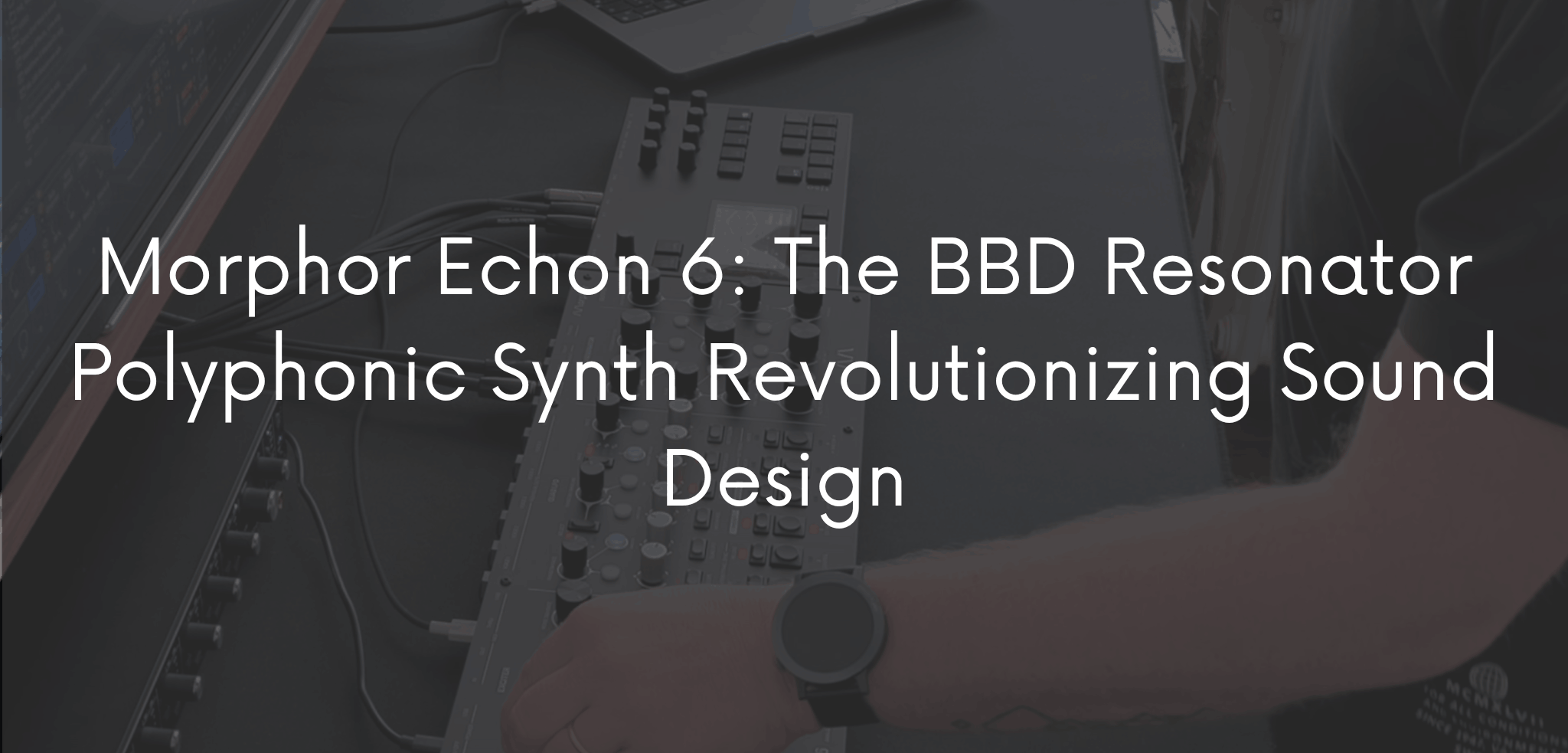
In the world of analog synthesis, things often move along predictable tracks: oscillator, filter, amplifier. But the moment the Morphor Echon 6 entered my studio, I immediately realized the rules of the game had changed. Crafted by the vanguard boutique brand Morphor and available via their official website echon6.com, this 6-voice analog polyphonic synthesizer is not just another vintage clone.
As a professional producer and sound designer, I can confidently tell you that the Echon 6 represents one of the most exciting design leaps in recent years: the perfect marriage between physical modeling synthesis principles and the unstable, organic warmth of analog circuitry.
But what makes it so unique, and more importantly, how does it fit into a modern production workflow? Let’s dive into this technical and hands-on review.
The Sonic Architecture: Beyond the Classic Oscillator
Most analog polysynths on the market rely on standard subtractive synthesis. The Echon 6 flips this paradigm by placing a 1024-stage BBD (Bucket-Brigade Device) resonator at the core of each voice.
BBD chips are historically famous for powering the warmest analog delays, choruses, and flangers on earth. Morphor has ingeniously engineered this technology so that the delay time precisely tracks the keyboard’s pitch.
The “Exciter” Section
Just as an acoustic string needs a plectrum or a bow to vibrate, the Echon 6 features an Exciter section to feed the BBD resonators with:
- A full analog VCO (capable of Sine, Triangle, Ramp, and Square waves).
- An analog S&H (Sample & Hold) noise circuit with dedicated crossfading.
- An external audio input to process external sound sources through the resonators.
3 Practical Sound Design Examples in the Studio with Echon 6
To give you an idea of what this machine can do, here are three real-world production scenarios taken straight from my recent cinematic and electronic music sessions.
1. Creating “Imaginary” Acoustic Instruments (Plucked & Bowed)
When scoring a film, I am always searching for sounds that blur the line between the real and the alien.
- The Setup: I mute the traditional VCO waveforms almost entirely and use a very short, explosive burst of S&H noise (an ADSR envelope with Attack at zero and a lightning-fast Decay).
- The Result: This sudden impulse “strikes” the BBD resonator. By tweaking the 6dB/oct feedback filter embedded within the resonator loop, I can recreate the wooden body resonance of an acoustic guitar or a cello pizzicato, but with a dense, gritty analog tail that samplers simply cannot replicate.
2. Evolving, Three-Dimensional Pads via the 9×32 Matrix
The Echon 6 shines when it comes to shifting harmonic textures, thanks to an incredibly immediate, menu-free 9×32 modulation matrix.
- The Setup: I assign one of the 4 polyphonic LFOs to the BBD clock frequency (the delay time) and a second LFO with inverted phase to the resonator’s stereo panning.
- The Result: By taking advantage of my master keyboard’s polyphonic aftertouch, I can press into the keys to dynamically open the resonator’s 12dB/oct input filter. This yields massive, orchestral-like pads that breathe, expand across the stereo field, and morph their timbre purely based on finger pressure.
3. Extreme Multitimbral Sound Design
As a 6-part multitimbral machine boasting independent stereo outputs for every single voice, the Echon 6 is an absolute studio monster.
- The Setup: I isolate voice 1 and voice 2, routing them to separate inputs on my audio interface. On voice 1, I dial in a deep sub-bass by pushing the BBD feedback right to the edge of self-oscillation. On the remaining voices, I program a lush polyphonic lead chord.
- The Result: I gain total control over the mix inside my DAW. I can heavily compress or EQ the analog sub-bass generated by the BBD without affecting the stereo width and airy highs of the main lead pattern.
User Experience: Goodbye Screens, Hello Tactile Control
As a producer, I spend far too many hours staring at a computer screen. The user interface of the Echon 6 is a breath of fresh air: there are no displays. Every primary function has its own dedicated knob or button on the aluminum chassis (which easily accommodates desktop use, 19″ rack-mounting, or VESA mounts).
Modulation routing is a masterclass in modern workflow: simply hold down the source button (e.g., LFO 1) and turn the destination knob (e.g., Feedback). Done. This level of immediacy transforms the synth into a true live improvisation partner.
Technical Specifications at a Glance
| Feature | Morphor Echon 6 Technical Specifications |
| Polyphony | 6 analog voices, configurable in unison, split, or layers |
| Sonic Core | 1024-stage BBD resonator per individual voice |
| Exciter Sources | VCO (Sine, Triangle, Ramp, Square) + S&H Noise + External Input |
| Filtering | 12dB/oct input filter + 6dB/oct filter inside the feedback loop |
| Modulation | 4 LFOs + 4 random generators per voice; 9 x 32 Modulation Matrix |
| Connectivity | MIDI In/Out/Thru (5-pin DIN & USB-C), independent balanced outputs |
| Power Supply | USB-C powered (9V, 15W) |
The Verdict: Is the Echon 6 Worth It?
The Morphor Echon 6 is not the synthesizer you buy if you are looking for classic, radio-friendly “Juno-style” sounds or standard pop leads. It is a specialized instrument built for electronic music producers, film composers, and sound designers who want to colonize unexplored sonic territories.
If you want to elevate your palette and step away from standard digital or subtractive synthesis, head over to echon6.com and check out the audio demos. Your studio workflow will never be the same.