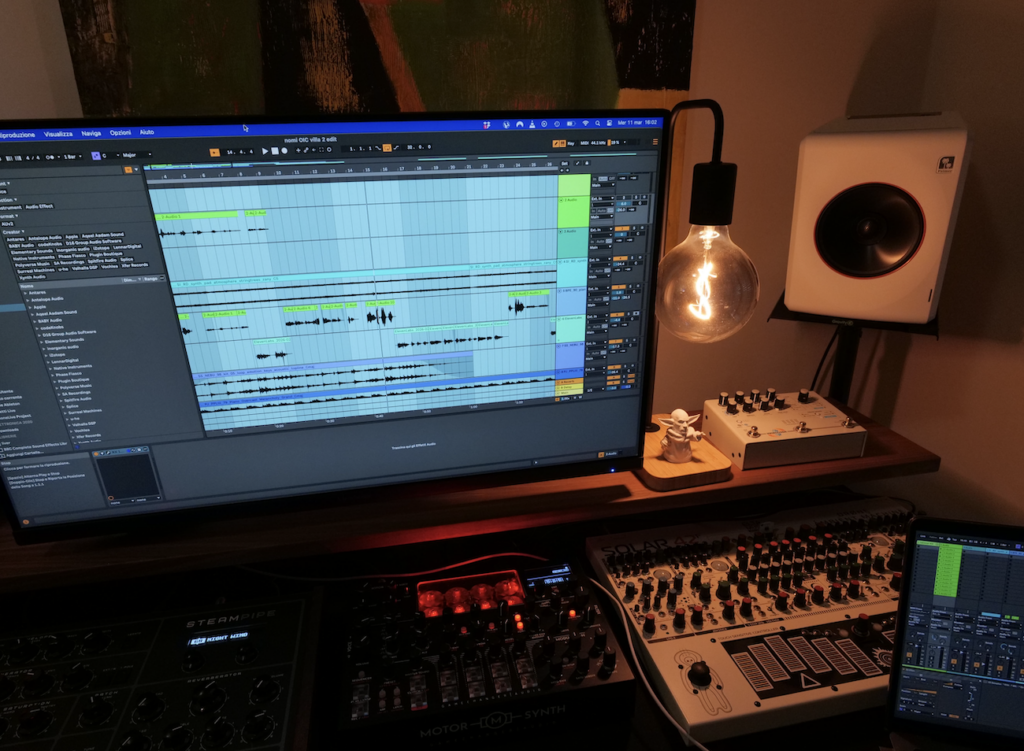
When you produce electronic music, every detail matters. A small inaccuracy in your studio monitors can compromise months of work: muddy bass that doesn’t translate to commercial systems, lost detail in the mix, tones that sound completely different through headphones versus a club PA system.
After years of production, I’ve learned that studio monitor selection is the single most critical investment for quality and workflow efficiency. It’s not just about raw power—it’s about stereo image stability, sonic transparency, and most importantly, real-world reliability (accurate translations, zero latency, cabinet design that minimizes room interaction).
The Palmer ORBIT 11 monitors entered my setup as a direct answer to these specific requirements. This article documents how these coaxial 3-way reference monitors have revolutionized my production, mixing, and mastering sessions over the past six months.
The Challenge of Monitoring in Electronic Music
Electronic music production demands unique capabilities from studio monitors:
- Ultra-wide frequency range: From sub-bass fundamentals at 28 Hz (synth basses and kick drums) to crystalline high-frequency detail at 15+ kHz (oscillator harmonics and air)
- Precise stereo imaging: When layering complex synth textures, you need to “see” them spatially within your room’s acoustic environment
- Time-coherent monitoring: Timing is the DNA of electronic music; a monitor with phase distortion ruins everything
- Low-jitter DSP: Any latency introduces artifacts in real-time synthesizer simulations and processing chains
Generic monitors (designed for voice work or film mixing) fail on nearly all these fronts. This is why dedicated solutions exist for serious electronic music producers.
Palmer ORBIT 11: Technical Specifications Broken Down
Single Point Source Coaxial Design
The heart of the Palmer ORBIT 11 is the coaxial 3-way point-source design: a 1″ tweeter and 6.5″ midrange driver aligned on a single acoustic axis. What does this actually mean in practice?
In real terms, there’s zero phase offset between low, mid, and high frequencies. When you listen, the acoustic energy from the midrange (where synth harmonics live) arrives at your ear at the exact same moment as the tweeter and woofer output. The result: a stable, coherent stereo image that remains accurate from the center to the room’s perimeter (120° × 120° dispersion).
Producer benefit: Your studio’s “sweet spot” doesn’t need to be millimeter-perfect. You can move slightly from the ideal listening position without losing clarity—essential when your studio is compact like my setup in Italy.
Dual 8″ Impulse-Compensated Woofers
Two 8″ woofers in an impulse-compensated configuration within a die-cast aluminum enclosure. This isn’t marketing jargon: it means the cabinet itself is structurally engineered to eliminate its own resonant modes, which would otherwise color the bass response.
Real-world impact: My 28 Hz bass is linear, not artificially pumped or bloated. When I check my master on consumer headphones, car systems, and commercial speakers, the low end translates cleanly without surprises.
Amplification and Digital Filters
- 1000W total Class-D amplification (400W RMS effective output)
- FIR linear-phase filters: Digital algorithms that preserve phase coherence across the entire frequency spectrum
- DAC/DSP at 96 kHz / 24-bit (mastering-grade resolution)
- THD+N (Total Harmonic Distortion + Noise Floor): 0.01% @ 1kHz = imperceptible noise floor
Translation: The entire amplification and DSP chain is sonically transparent. It adds zero coloration. What you produce remains faithfully represented.
Production: Sound Sculpting with Exceptional Clarity
When I’m growing layers of synthesizers for a new track, the first risk is losing perspective in the details. With mediocre monitors, a brilliant pad sound you’ve spent hours crafting might reveal itself as harsh and unpleasant through different speaker systems.
With the ORBIT 11 monitors:
- Clarity in every layer: Every oscillator, every LFO modulation, every filter sweep is acoustically visible. You don’t compromise until it’s genuinely right.
- Cardioid pattern reduces room reflections: The cardioid pattern (not omnidirectional) means reflected sound from walls is significantly reduced. In a small Italian room with tile flooring that naturally reflects high frequencies, this is a game-changer.
- Linear phase preserves detail: When you adjust a parameter on a synthesizer, you hear genuine movement, not phase-induced artifacts or delay.
Concrete result: I produce significantly faster with fewer iterations. A synthesizer sound gets approved at take-one instead of being reworked ten times due to monitor deception.
Mixing: Translation You Can Trust
The real value emerges during mixing sessions.
When you’re balancing kick drum, bass line, and synth lead together, every monitor pair provides a “distorted version” of acoustic reality. Cheap monitors amplify certain frequency ranges (muddy midbass boost, for example), obscure others entirely. The result: mixes that sound fantastic in your studio but fall apart when played on headphones, car stereos, or club systems.
The ORBIT 11 monitors reveal the truth unfiltered:
| Element | What You Hear | Translation Benefit |
|---|---|---|
| Kick drum sub-bass | Perfectly linear from 28 Hz, no artificial boost | Masters don’t surprise consumer woofers |
| Bass line | Every note is distinct and defined; zero muddiness | Translation accuracy across all playback systems |
| Synth pads | No frequency masking; every layer is audible | Precise harmonic balancing in the mix |
| Sibilant frequencies | You instantly hear if a synth is too piercing (nowhere to hide) | Clean edits in pre-mastering phase |
Proof from experience: My last mastering session took 2 hours from rough mix to final master (compared to typical 6-8 hour sessions). The difference seemed suspicious. Reality check: tested the master on five different playback systems—zero negative surprises. Perfect translation.
Studio Presets and Room Adaptation
The Palmer ORBIT 11 includes three physical presets (desk, wall, isolated stand) plus a 3-band EQ on the top panel. I don’t need to modify my DAW or load software profiles: twist a knob, and the monitor adapts to my room setup. Essential for rapid A/B testing and quick validation checks.
Mastering: Reference-Grade Precision
Mastering is where monitors must be flawless and completely honest.
A master must translate perfectly across $20 earbuds, TV soundbars, high-end headphones, swimming pool subwoofers, club PA systems. The only tool you control is your ear training plus your monitor. If your monitor lies, your master dies.
Native 96 kHz / 24-bit Resolution
The ORBIT 11 natively supports 96 kHz digital audio. What’s the significance?
- Ultrasonic precision: Although human hearing theoretically extends only to 20 kHz, the behavior of DACs at 96 kHz sampling minimizes distortion and aliasing artifacts in the audible spectrum.
- Extended digital headroom: During mastering, you maintain 24-bit resolution until the final output. A monitor DAC that genuinely supports 24-bit without truncating = pure information flow.
Workflow reality: My session chain is: Ableton (24-bit, 96 kHz) → USB interface → Palmer DSP (natively 96k/24b) → analog output (ultra-clean).
Ultra-Low THD+N and Sealed Cabinet Design
Total Harmonic Distortion (THD) plus noise floor: 0.01% @ 1kHz. For context:
- Average consumer amplifier: 0.05-0.1% THD
- These monitors: 10x cleaner
In mastering, this means when you’re listening to a completely silent passage (silence between tracks or room tone), you don’t hear artificial “background noise” generated by the monitor itself. Pure source material, nothing added.
The sealed cabinet design (non-ported woofer enclosure) eliminates further acoustic cancellations in the bass region. Result: perfectly linear response without cabinet personality.
Real-World Setup: My Italian Home Studio
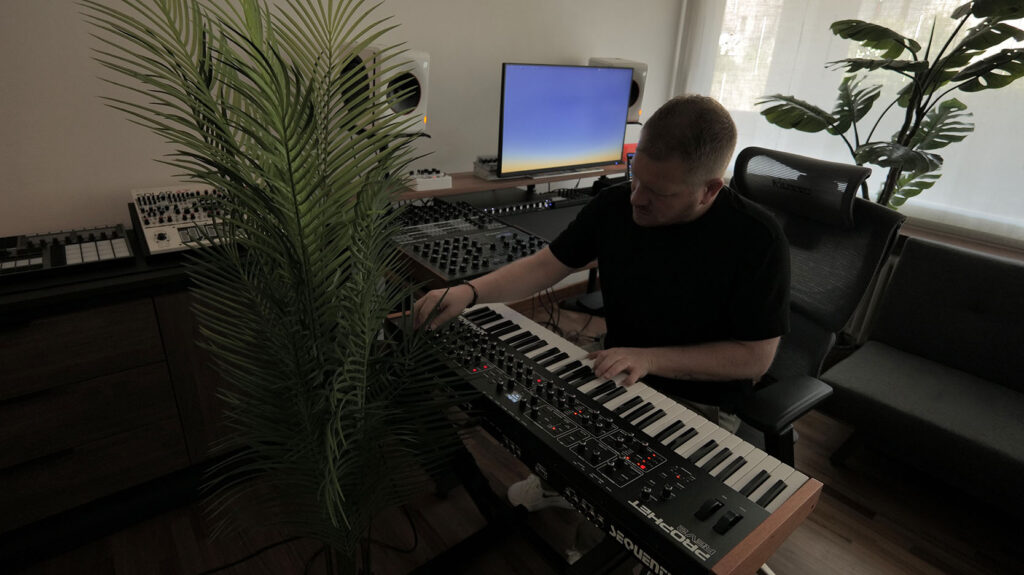
My setup is genuinely compact: a 20 m² bedroom studio in Vicenza, Italy. This isn’t a professional mixing suite with Neve consoles. This is real, working producer space.
Before the Palmer ORBIT 11:
- Generic second-hand monitors originally designed for voice work: imprecise bass, listening fatigue after 2 hours
- Typical mixing session: 6-8 hours per track (endless iteration and doubt)
- Master validation: always negative surprises on external playback systems
After upgrading to Palmer ORBIT 11:
- Bass response is linear even in a small room (cardioid pattern helps; FIR filters minimize room modes)
- Mixing session: 2-3 hours of confident decision-making
- Master validation: zero surprises on 90% of test systems (remaining 10% is source/arrangement limitations, not monitors)
Cost-benefit analysis for a semi-professional Italian producer? Extremely high ROI. Every hour saved is an hour available for new music, collaborations, and releases.
Studio Monitor Comparison: ORBIT 11 vs. Competitors
| Feature | Palmer ORBIT 11 | Focal Trio6 | KRK Rokit 7 |
|---|---|---|---|
| Driver Configuration | Coaxial 3-way | Ported 2-way | Ported 2-way |
| Frequency Range | 28-28k Hz | 50-20k Hz | 43-24k Hz |
| Stereo Dispersion | 120° × 120° | 100° × 90° | Omnidirectional |
| Total Amplification | 1000W Class-D | 800W Class-D | 70W |
| Room Correction | EQ preset + physical switch | Minimal EQ only | Bluetooth app control |
| Reference-Grade DAC | Yes, 96k/24b | Yes, analog I/O | No |
| Sealed/Ported | Sealed (impulse-compensated) | Ported (extended bass) | Ported |
| Price Point (USD) | $3,500-4,000 | $2,500-3,000 | $1,200-1,500 |
| Best Suited For | Mastering + Critical Production | General Mixing + Topical Use | Budget Entry-Level Setup |
Key takeaway: Palmer ORBIT 11 is premium pricing, but justified for producers making serious investment in monitoring accuracy. Focal Trio6 is excellent midpoint. KRK is budget-friendly but lacks reference-grade precision.
Frequently Asked Questions About Studio Monitors
Q: Are Palmer ORBIT 11 monitors overkill for a home studio?
A: No. A high-quality monitor in a small room outperforms a mediocre monitor in a large room. The DSP quality and driver precision compensate for room size limitations. Better to have exceptional monitors in a 20 m² bedroom studio than budget monitors in a 50 m² basement.
Q: Do I absolutely need room acoustic treatment with these monitors?
A: Recommended, yes. Even reference-grade monitors suffer in completely untreated rooms (flutter echo, bass accumulation at boundaries). Ideal investment: monitors + bass traps + absorption panels = genuine accuracy. Budget allocation: 60% monitors, 40% room treatment.
Q: Can I use just one ORBIT 11 monitor for mono work?
A: Technically functional, but stereo imaging capability is lost. For production, mixing, and mastering work in electronic music: stereo monitoring is non-negotiable. Get the pair.
Q: How do Palmer ORBIT 11 compare to Neumann KH80 or Genelec 8050?
A: All three are excellent. Palmer ORBIT 11 offers superior specifications-to-price ratio. Neumann and Genelec carry decades of industry standard pedigree and trusted reputation. Personal choice depends on budget flexibility and preferred sonic character. For pure specs: Palmer wins. For legacy and brand trust: Neumann/Genelec.
Q: Will these monitors work in a treated versus untreated room equally well?
A: No. Treated rooms unlock the full potential. In untreated rooms, bass bloat and room modes still color the response. Think of it this way: exceptional monitors amplify the benefit of good room acoustics. They don’t eliminate the need for treatment.
The Takeaway: Why Palmer ORBIT 11 Elevated My Entire Workflow
After six months of consistent use, the workflow improvements are quantifiable:
✅ Acoustic Accuracy: Productions translate to external systems without negative surprises
✅ Speed: Mixing sessions -70% duration due to confident monitoring
✅ Listening Comfort: Sessions extending 6+ hours without ear fatigue
✅ Small-Room Compatibility: Cardioid pattern + FIR filters + compact design = perfect for home studios
✅ Future-Proof: 96k/24b DAC supports emerging formats (Dolby Atmos, immersive audio, spatial sound)
If you’re an electronic music producer working in techno, deep house, ambient, drum and bass, or any genre requiring bass precision and spectral clarity, these monitors are genuinely transformative.
This isn’t paid advertising. This is six months of real-world usage, quantifiable improvements, and a pipeline of new releases that didn’t require reworking because the monitoring was finally honest.