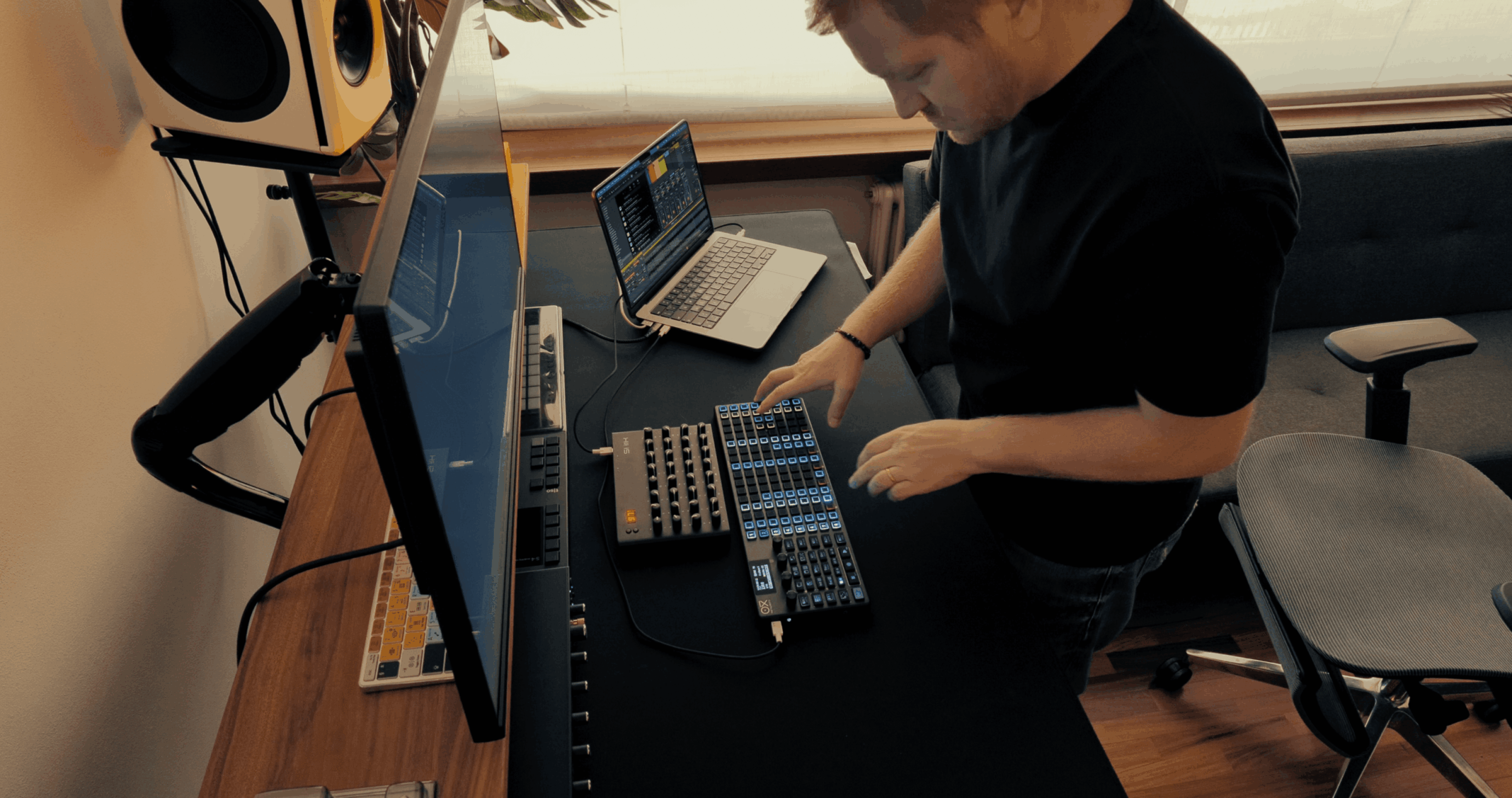
Over the past few months, I’ve been bringing a more performative dimension into my music-making. The computer remains at the heart of my setup, but it is no longer the only place where the music happens.
This is where OXI One MKII has become particularly interesting to me. What I like most is the way it turns sequencing patterns into something that feels much closer to playing an instrument.
For this session, I decided to combine Ableton Live, OXI One MKII and the Shik N32B Slim. I didn’t start with a completely finished track. Instead, I wanted to build a techno live performance directly in my studio.
The sequences, rhythmic changes and interaction between hardware and software shaped the direction of the music as I played. The result is the performance you can watch in the video below.
OXI One MKII: when a sequencer becomes an instrument
One of the things I enjoy most about OXI One MKII is the relationship between what I’m programming and what I’m actually hearing.
When I work in Ableton Live, I’m used to having very precise control over every part of a production. During a performance, however, that level of precision can sometimes become limiting. This is especially true when everything has already been decided in advance.
With OXI One MKII, I found a different approach. I can interact directly with sequences while the music is playing. I can modify patterns, create variations and build new combinations without breaking the flow of the performance.
I’m not simply triggering clips or starting elements that were prepared beforehand. I’m making musical decisions while the performance is happening.
And I can hear the difference.
After many years of working with Ableton Live, I’ve learned how easy it is to get lost in the endless possibilities offered by software. Having more options doesn’t always mean being more creative.
Sometimes, a more focused instrument can help you make decisions faster. It can also help you stay connected to the music.
That is one of the things I appreciate most about OXI One MKII. It doesn’t try to replace Ableton Live. Instead, it gives me a different and more direct way into the music.
Ableton Live remains at the heart of my setup
My relationship with Ableton Live goes back many years. It continues to be a fundamental part of the way I produce and perform electronic music.
I wasn’t looking for a device that could replace my computer. I also didn’t want to completely change my existing workflow.
I wanted something that could work alongside my setup. At the same time, I wanted to move towards a more physical and performative way of making music.
That is where OXI One MKII fits really well.
Ableton Live remains the environment where I manage instruments, effects, routing and the overall structure of the performance. OXI One MKII gives me a more direct way of working with sequences and rhythms.
During a techno performance, this becomes particularly interesting. Rhythm is no longer just something I program during production. It becomes something I can interact with in real time.
Building a techno performance without knowing exactly where it will go
When I record a session like this, I’m not necessarily trying to create a finished track.
I’m more interested in seeing what happens when certain elements are left open. They can then evolve naturally during the performance.
I find this approach particularly suited to techno. A small change in a sequence or rhythm can completely change the way the music feels.
OXI One MKII allows me to work with these kinds of variations in a very direct way. I can start with a simple structure and gradually make changes as the performance develops.
The groove can evolve alongside the other elements I’m controlling in Ableton Live. This makes the process feel less like playback and more like an actual performance.
The Shik N32B Slim adds another layer of control to the setup. For this particular session, however, OXI One MKII was the starting point.
I wanted to explore how differently I could approach a techno session when the sequence becomes something I can manipulate while I’m playing.
Technology should serve the music
Over the years, I’ve worked with many different instruments, controllers and pieces of electronic music equipment.
One thing I’ve learned is that having interesting hardware doesn’t automatically make the creative process more interesting.
For me, the question is always the same:
Does this instrument make me want to play?
That question matters more to me than a list of technical specifications. This becomes especially important when working on a live performance.
A device can be incredibly powerful. But if using it constantly forces me to stop the musical flow, it can quickly become an obstacle.
With OXI One MKII, I’ve found a much more natural relationship. I can see and edit sequences while making quick changes to patterns.
This allows me to stay focused on listening. For me, listening has always been the most important part of the process.
Technology should eventually disappear enough for you to think about the music instead of the technology itself.
OXI One MKII in my workflow
I don’t see OXI One MKII simply as another MIDI controller. For me, it is becoming a genuine creative instrument.
This is especially true when I want to move away from the traditional studio-production mindset. I can use it to explore a way of working that feels much closer to performing.
That is exactly what I wanted to explore with this session.
How different can it feel to produce and perform when an important part of the composition happens during the performance itself?
The interesting part is that every performance can be slightly different. A sequence might take an unexpected direction. A pattern might suggest a completely different idea.
Even a simple rhythmic variation can become the starting point for something new.
For me, that is the real value of instruments like OXI One MKII. It’s not necessarily about doing more. It’s about interacting better with what you’re already doing.
Watch my live techno performance
I recorded this session in my studio using Ableton Live, OXI One MKII and the Shik N32B Slim.
The goal was to capture a real moment from my workflow. I didn’t want to create a technical demonstration of the products.
This performance represents the direction I’m exploring at the moment. I’m interested in a way of making electronic music where production and performance meet.
It leaves more room for improvisation and interaction with the instruments.
In that sense, OXI One MKII has become much more than a controller for me. It has become a connection point between the idea I have in my head and what actually happens when I start playing.
That is probably why I keep coming back to this setup.
When technology becomes a natural part of the musical gesture, it becomes much easier to forget about the equipment and focus on the music.